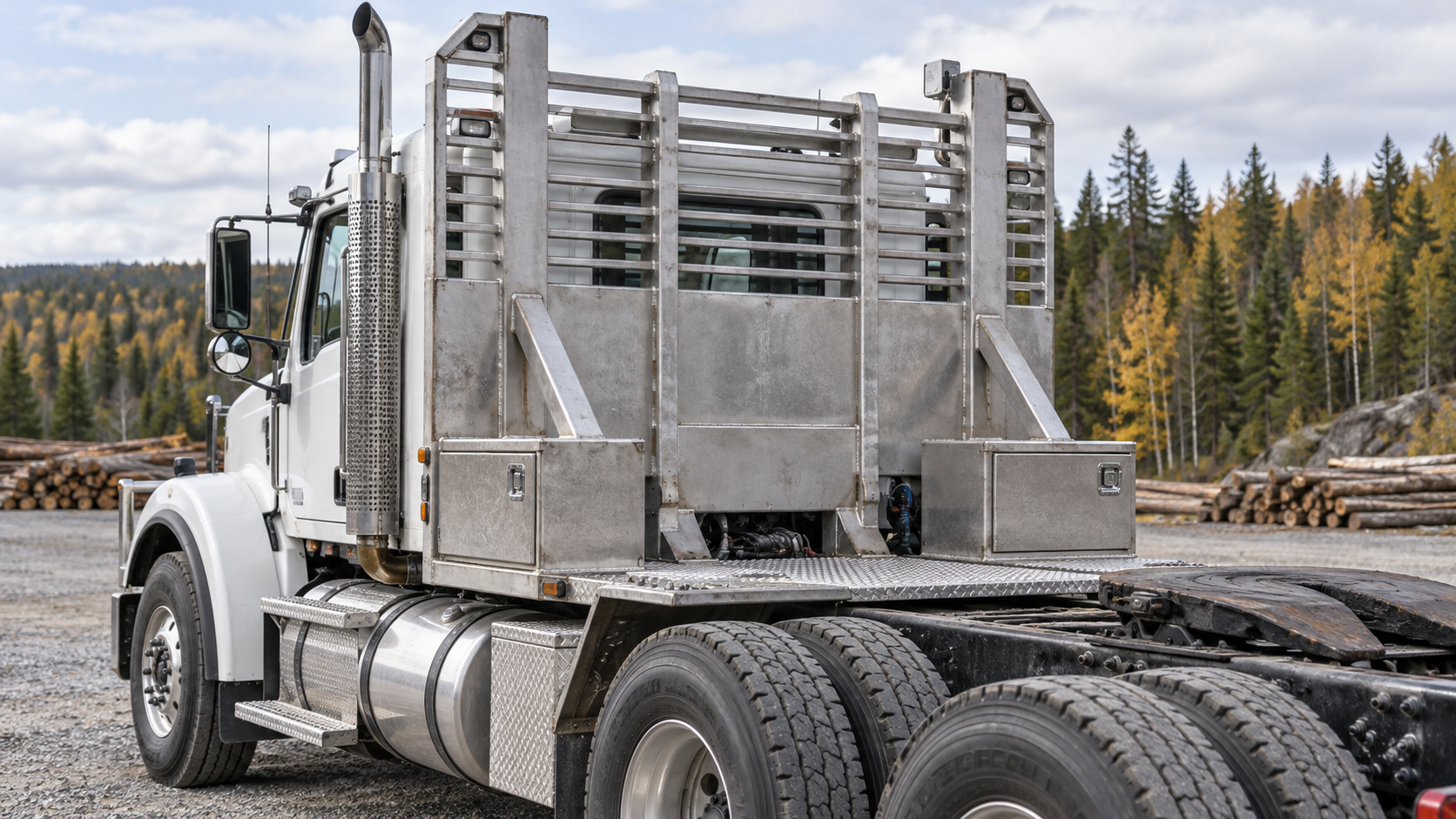
Looking for a used cab guard or logging deck? Maybe you’ve already found one that looks right for your truck. Before you buy it, grab a tape measure and take a closer look at a few details.
Is there enough room behind the cab? Will the brackets work with your frame? Are the toolboxes included? Most importantly, was the unit built for the work you do?
At Gamex, you can browse our used cab guards and cab racks. Here’s what to check before choosing one for your truck.
What’s the best used cab guard for your truck?
That depends on your truck and what you haul. If you’re hauling logs, you need equipment designed for that application. If you mainly need a place to store chains and gear, you may be looking for a different type of rack.
A large logging deck with several storage boxes can be useful, but you need enough room to mount it. A smaller unit may fit your truck better, provided it’s suitable for the job.
Before comparing prices, check three things: what the unit was designed for, what condition it’s in and how it will mount to your truck. Then look at the accessories and installation costs.
Cab guard, headache rack, cab shield or logging deck?
You’ll come across several names when shopping for used truck equipment: cab guard, cab rack, headache rack, back rack and cab shield. You may also see forestry units advertised as logging decks or forestry decks. In Quebec, sellers often use the French term deck forestier.
The wording varies between listings, but that doesn’t mean every unit does the same job. Some racks are designed to hold chains and equipment behind the cab. Others are built for logging applications.
If you haul logs, ask for the manufacturer and model. That information helps you check the intended use and any restrictions. A rack’s appearance—even if it looks heavy-duty—doesn’t tell you what protection it provides.
Start with the right measurements
A photo gives you a general idea of the unit. It won’t tell you whether a toolbox will sit too close to the exhaust or whether the mounting feet will line up with your frame. Before making the trip, measure your truck and ask for the cab guard’s dimensions.
Height and width
Ask where the height measurement starts: at the bottom of the mounting feet, at the platform or at the top of the truck frame? You need the same reference points to make a useful comparison.
For width, check both the overall width and the spacing between the mounting feet. A cab guard can be the right width overall without having the right mounting arrangement for your truck.
Depth, including storage boxes
Check how far the deck extends forward and back from its mounting points. Toolboxes, steps and storage brackets take up room too. Leave enough space to open the lids and reach the contents.
If a measurement is missing from the listing, ask for it. A photo with a tape measure can clear up a lot, as long as you can see exactly where the measurement starts and ends.
Clearance around the cab guard
Look at everything behind your cab: exhaust, tanks, air lines, wiring and other equipment. You’ll need the required clearance around those parts, along with access for maintenance.
On a tractor, the trailer also needs room as it turns. A unit that appears to fit while the truck is parked straight still needs to be checked for cab movement and trailer swing. Have the installer confirm those clearances.
Will a cab guard from a Kenworth fit a Western Star?
It may, but the truck brand alone won’t give you the answer. Even two trucks from the same manufacturer can have differences that affect the installation.
Whether you run a Kenworth, Peterbilt, Western Star, International, Freightliner, Volvo or Mack, check the frame dimensions, mounting brackets and available space. Tanks or crossmembers may be in the way of the required mounting hardware.
If you’re replacing an existing cab guard, take photos of the mounting arrangement before removing it. Write down the measurements and any model information. You’ll have something concrete to compare with the units you find.
Don’t assume you can reuse the old brackets and bolts. Their condition, compatibility and the manufacturer’s instructions all need to be checked. Some installations require new mounting hardware.
Buying used: where to look for problems
A few scratches are one thing. Structural damage is another. When checking a used cab guard, pay particular attention to the uprights, welds, mounting feet and the areas where it was attached to the truck.
Ask for photos from every side, including the back and underneath. A single front view can leave a lot out.
- Uprights and platform: does anything look bent, twisted or sagging?
- Welds: can you see cracks, previous repairs or added reinforcement?
- Mounting feet and brackets: are they complete? Are there elongated holes or sections that have been cut?
- Corrosion: check the base, joints and areas where water and dirt can collect.
- Repairs: ask what was repaired and whether any information about the work is available.
Fresh paint can improve the appearance, but it doesn’t tell you what’s underneath. If a weld, bent section or previous repair raises questions, have the unit assessed before buying it to put back into service.
Aluminum or steel: which should you choose?
Cab guards are available in aluminum and steel. When comparing them, look at the complete units: their weight, dimensions, condition and intended use.
If added weight matters to your operation, ask for the weight of the unit with its boxes and accessories. Comparing a small rack with a fully equipped logging deck won’t tell you much about the difference between the two materials.
Either way, inspect the structure carefully. Aluminum still needs to be checked for damage, and a steel unit isn’t automatically a better choice for your work.
Toolboxes, lights and accessories: what’s included?
A chain box in the right spot is useful. A lid that won’t open once the deck is installed isn’t. Think about how you’ll use each accessory with the cab guard mounted on your truck.
Confirm what comes with the sale: boxes, lids, brackets, lights, wiring and mounting parts. Everything shown in a photo may not be included.
Check the hinges, latches and bottoms of the storage boxes. If the unit has lights, ask whether they’ve been tested. That will help you figure out what’s usable and what needs to go into your budget.
The purchase price is only part of the cost
Found two units at different prices? Before choosing the cheaper one, work out what each will need: freight, inspection, brackets, hardware, missing accessories and installation.
A lower-priced unit without the mounting parts you need may end up costing more than one that’s better suited to your truck. Get an installation estimate before making your decision.
If a unit is damaged, don’t simply add a repair allowance to the budget. First, find out whether it can be repaired properly and returned to service for the intended use.
Buying used makes sense when you know what you’re getting and what still needs to be done. If the measurements, condition or installation requirements are unclear, sort those out before moving ahead.
Looking for a used cab guard or logging deck at Gamex?
Start by browsing our used cab guards and cab racks. If you find a unit that interests you, note the stock number and contact us for the available details.
Have the following information ready:
- Your truck’s make, model and year.
- The type of work you do with the truck.
- Measurements of the space behind the cab.
- A few photos of the frame and existing mounting arrangement, if there is one.
- The stock number of the unit you’re interested in.
Those details make it easier to discuss dimensions, condition and included accessories. Availability should also be confirmed, since inventory changes as parts arrive and sell.
Contact the Gamex team to ask about a unit. If you need other components for your truck, you can also browse our used heavy truck parts inventory.
Questions about used cab guards and logging decks
What is a logging deck?
In this context, a logging deck is an assembly mounted behind the cab of a truck used in logging. Depending on the model, it may include a cab shield, platform and storage boxes. Check what comes with the unit and what the manufacturer designed it to do.
Is a headache rack the same as a logging cab guard?
Not necessarily. Some racks are designed to store chains and equipment. For logging, you need a unit designed for that application. The listing name alone isn’t enough—ask for the manufacturer and model.
How do I know whether a cab guard will fit my truck?
Compare its height, width, depth and mounting points with your truck’s measurements. You also need to check clearance around the cab and trailer. Have your installer confirm the mounting arrangement before you buy.
Are mounting brackets included with a used cab guard?
It depends on the unit. Ask what comes with it and what you’ll need to buy separately. Even if brackets and bolts are included, check whether they suit your truck and whether the manufacturer allows them to be reused.
How much does a used cab guard cost?
The price depends on the model, condition and included accessories. Contact Gamex with the unit’s stock number for pricing. Remember to include freight and installation when working out your budget.
How can I check whether a unit is still available at Gamex?
Contact the team with the stock number shown in the listing. You can confirm availability and ask about measurements, condition and included accessories.